WRITING / ARCHIVE
How I Turned Macro Outlooks into ETF Portfolios and How They Performed by Year-End 2025
TL;DR
At the start of 2025, I translated macro outlooks from Bloomberg, JP Morgan, HSBC, Trump Executive Orders and Guidance from the All-in Podcast (Besties) into real ETF portfolios using ChatGPT and tracked them through the year. By December 29, 2025, all portfolios delivered double-digit returns, with the most diversified strategies matching or slightly outperforming global benchmarks on a risk-adjusted basis. The key takeaway wasn’t superior prediction, but better portfolio structure: balanced, macro-aware portfolios produced smoother returns than thematic or speculative bets. For African investors in particular, the experiment reinforces a simple idea — thinking globally and diversifying across assets matters more than chasing headlines.
Background
At the start of 2025, I read the global macro and investment outlooks published by leading institutions such as Bloomberg, JP Morgan, and HSBC. These reports are widely read, frequently quoted, and often shape how institutional capital is positioned. But as an individual investor, especially one investing from Africa, I kept coming back to the same question: how do you actually implement these views in practice?
Rather than treat the outlooks as high-level commentary, I used ChatGPT to translate each institution’s macro narrative into a concrete, investable ETF portfolio. Each portfolio effectively became a custom index, reflecting how that institution expected the year to unfold. I then invested in those portfolios in January 2025 and tracked their performance through the year without changing allocations.
To see the exact portfolios, see in the article here.
What the Portfolios Were Trying to Do
Bloomberg’s outlook leaned toward balance. It expected slower but positive growth, resilience in US technology, continued infrastructure spending, and a role for bonds in cushioning volatility. The resulting portfolio blended equities, infrastructure, emerging markets, and credit.
JP Morgan’s outlook centred on a “soft landing” scenario. Growth was expected to slow without tipping into recession, inflation to cool gradually, and markets to reward quality assets. Its portfolio reflected this with diversified global equities, bonds, and real estate exposure.
HSBC took a more growth-oriented stance. It was more constructive on emerging markets, infrastructure, and innovation, accepting higher volatility in exchange for higher potential upside.
I also included a more speculative portfolio — the Trump Opportunities Fund — built around themes such as defence spending, energy security, and crypto-related exposure. This was deliberately more concentrated and risk-on.
Year-End Performance: The Numbers
By the end of December 2025, all portfolios finished the year in positive territory and delivered double-digit USD returns.
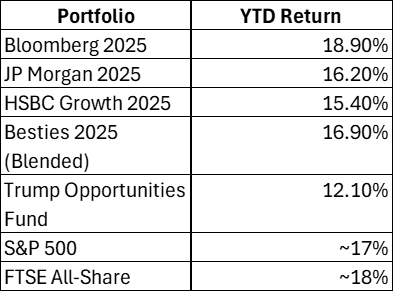
The Bloomberg 2025 portfolio led the group, finishing up about 18.9% for the year. JP Morgan 2025 followed at roughly 16.2%, while HSBC Growth 2025 delivered around 15.4%. The Trump Opportunities Fund ended the year up about 12.1%, recovering meaningfully from mid-year volatility but still lagging the more diversified strategies.
For context, the S&P 500 and FTSE All-Share also finished the year strongly, both in the high-teens.
At face value, this suggests that the macro-aligned portfolios broadly kept pace with global benchmarks. But the more important story sits beneath the headline returns.
Risk-Adjusted Performance: Why the Journey Matters
When viewed through the lens of Sharpe ratios, the differences between portfolios become clearer.
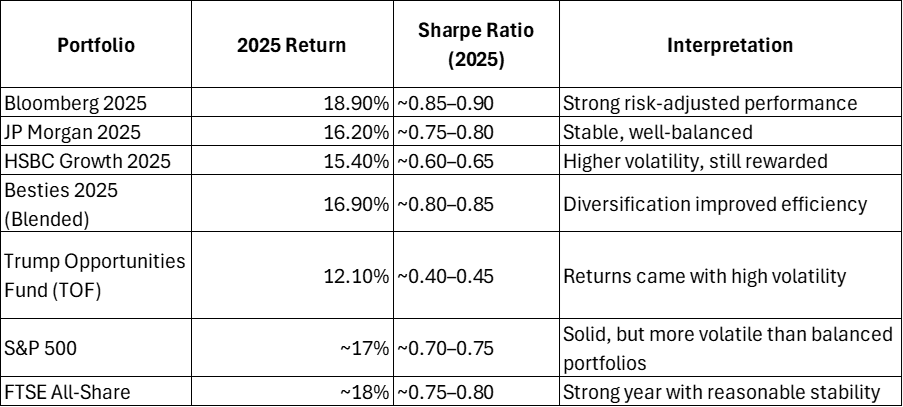
The Bloomberg portfolio recorded the strongest risk-adjusted performance, with a Sharpe ratio close to 0.9. This reflected not just high returns, but relatively smooth performance through the year. JP Morgan’s portfolio followed closely, with a Sharpe ratio in the 0.75–0.8 range, reinforcing its reputation as a steady, balanced strategy.
HSBC Growth finished with a lower Sharpe ratio, around 0.6, despite strong returns. This was expected. Emerging markets and innovation exposure introduced more volatility, and investors had to tolerate larger swings to earn those gains.
The Trump Opportunities Fund had the lowest Sharpe ratio of the group, around 0.4. Although it ended the year positive, it required significantly more risk to get there. This neatly illustrates why headline returns alone can be misleading.
Interestingly, both the S&P 500 and FTSE All-Share posted Sharpe ratios below the Bloomberg and JP Morgan portfolios. Broad markets performed well in 2025, but diversified macro-aware portfolios achieved similar outcomes with less volatility.
What 2025 Confirmed About Macro-Driven Investing
Looking back, none of the institutions predicted the year perfectly. Inflation moderated but didn’t disappear. Interest rates stayed restrictive longer than expected. Emerging markets contributed later than anticipated. Innovation worked, but selectively.
Yet the portfolios still worked because they were built for uncertainty, not precision. Diversification across assets, regions, and risk types mattered more than getting any single call exactly right.
This is also where ChatGPT proved useful. Not as a forecasting tool, but as a translator. It helped convert abstract macro language into investable structures. Human judgment still mattered, particularly around sizing risk and staying invested, but the distance between theory and execution was meaningfully shortened.
Is This Better Than Buying a Global Index?
Not necessarily, and that’s an important point.
For many investors, simply buying a global equity index and holding it remains a very strong strategy. It is low-cost, simple and historically difficult to beat over long horizons.
Where this approach adds value is in risk management and intentional tilting. Macro-aligned portfolios allow investors to adjust exposure consciously, manage volatility, and understand why portfolios behave the way they do. The most sensible conclusion is not replacement, but layering: a global index as the core, with macro or thematic allocations as overlays.
What This Means for African Investors
For investors in Uganda and across Africa, this experiment reinforces the case for thinking globally. Local markets are often concentrated illiquid, and exposed to currency risk. Global ETFs offer diversification that is difficult to achieve domestically.
Execution is no longer the barrier it once was. With USD funding channels, international brokerage access, and increasingly flexible financial infrastructure, global investing is becoming practical rather than aspirational.
Closing Reflection
The 2025 experiment wasn’t about beating the market. It was about testing whether macro views could be translated into real portfolios and held through a full cycle.
The answer clearly is yes, but only when structure and discipline come first.
For me, the most valuable outcome was not the return number, but the clarity it brought to process. In an uncertain world, portfolios don’t need perfect forecasts. They need to be built to survive being partly wrong.
Disclaimer: This article is for informational purposes only and does not constitute investment advice. Please consult your financial advisor before making any investment decisions.
Professional overthinker. Occasional optimist. Building a platform for #InvestinAfrica - driving impact through capital, innovation, and technology.